Identity can be separated from the object
Tags, serial numbers, certificates, and digital records can be copied, transferred, substituted, or detached from the physical asset they are meant to identify.

Provenia develops trust infrastructure for the physical world.
Binding physical identity, authorized control, provenance, and operational history into a persistent trust architecture for high-value assets, commercial systems, and mission-critical environments.
Most authentication systems verify a record, identifier, credential, or database entry.
Provenia is developing PASS Key, a trust infrastructure designed to bind cryptographic identity directly to physical assets and systems, then preserve the history of identity, custody, authority, and state over time.
The goal is not simply to prove that a record is valid. It is to establish confidence that the physical asset, the digital identity, and the authorized party remain connected.
As physical assets become increasingly connected to digital records, registries, ownership systems, autonomous platforms, and institutional workflows, one problem remains unresolved:
Tags, serial numbers, certificates, and digital records can be copied, transferred, substituted, or detached from the physical asset they are meant to identify.
Assets move between owners, operators, institutions, jurisdictions, and systems. Trust must survive those transitions.
Critical systems may operate beyond continuous access to a central authority.
A valid database record does not necessarily prove that the physical object presenting that identity is genuine.
PASS Key is Provenia's hardware-rooted trust architecture for establishing and maintaining a verifiable relationship between a physical asset, its cryptographic identity, its authorized users, and its operational history.
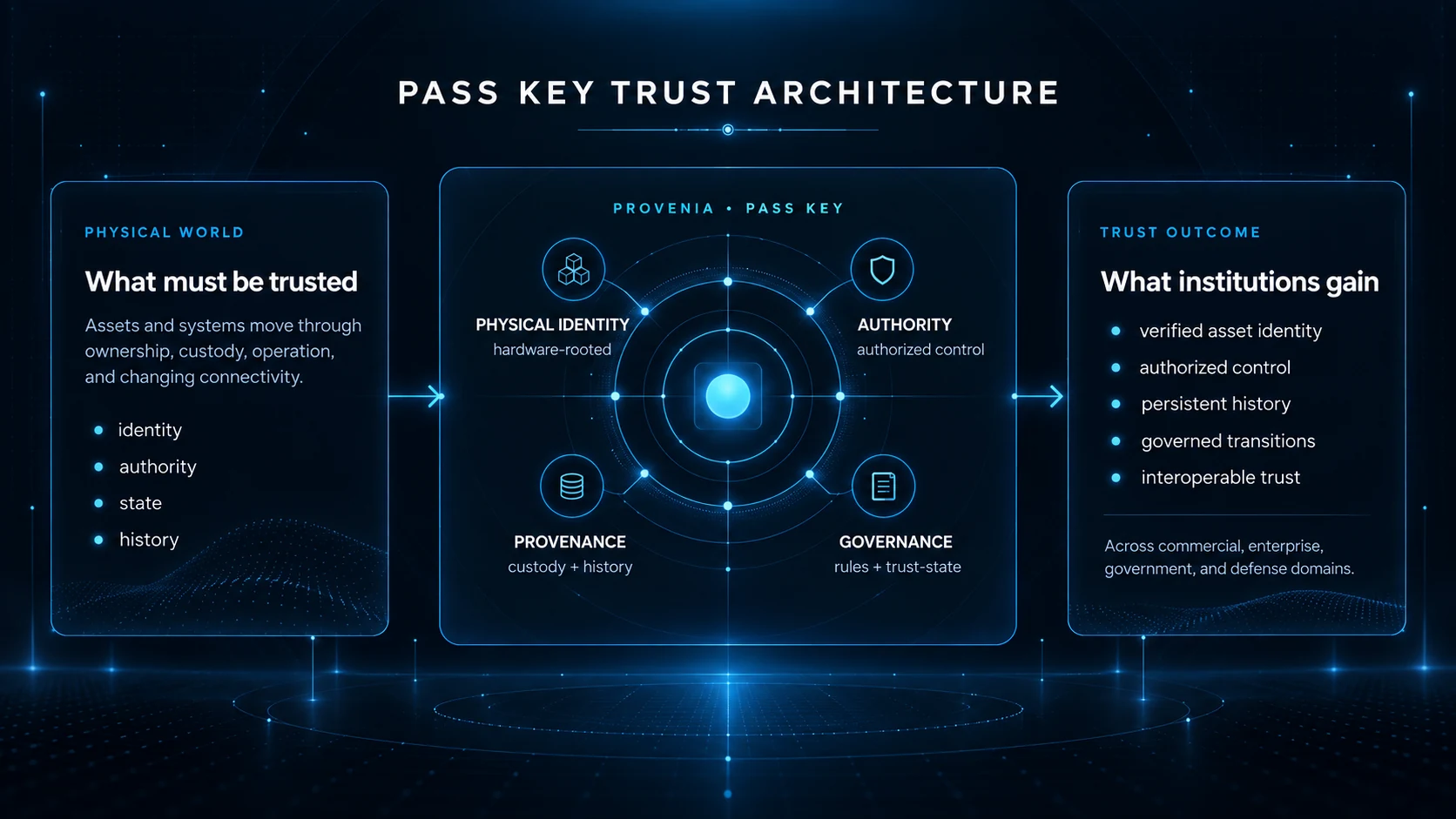
Cryptographic identity rooted in the physical asset rather than a detached record alone.
Verification of who or what is authorized to own, control, operate, or transfer it.
A persistent history of custody, ownership, state, and material events.
Rules governing trust-state, verification, transfer, compliance, and institutional use.
A common architecture can preserve trust as assets move through ownership, custody, operation, location, and changing connectivity.
Establish hardware-rooted identity and authorized trust relationships.
Maintain verifiable identity and authority as conditions change.
Validate events, state changes, and authority when systems synchronize.
Traditional systems are record-centric. Provenia is being developed as asset-centric infrastructure.
Verify a certificate, tag, database entry, serial number, ledger entry, or credential.
Establish a persistent relationship among the physical asset, cryptographic identity, authorized party, trust state, and operational history.
Provenia is being built as infrastructure rather than a point solution, intended to support multiple asset classes, institutional workflows, and operating environments through a common trust foundation.
A layered architecture designed to keep identity, authority, state, and institutional verification connected.
A cryptographic identity anchored to the physical asset rather than a detached digital record alone.
Designed to detect when the trust anchor has been removed, transplanted, or separated from the asset it represents.
Identity can be associated with authorized ownership, custody, operation, or institutional control.
Material changes in identity, custody, authorization, or system state become part of the object's verifiable history.
Trust policies can be applied across insurers, registries, enterprises, government systems, and other participants.
A common trust architecture extending across commercial applications and mission-critical defense environments.
Ownership, provenance, operation, insurance, and compliance increasingly depend on digital systems.
Machines are increasingly making or executing decisions without continuous human supervision.
Digital records cannot eliminate fraud when the physical object itself can be substituted.
Insurers, manufacturers, registries, governments, and operators increasingly depend on shared verification.
Provenia has one common hardware-rooted trust architecture addressed through two complementary patent families, with multiple application domains encompassed within the Commercial Patent Family.
Wilson Sonsini Goodrich & Rosati is advising Provenia in connection with patent strategy and filings.
Provenia is advancing through a deliberate sequence from protected intellectual property to validation, pilot programs, commercialization, and standards-scale adoption.
Portfolio established and prosecution underway.
Industry and government engagement.
Technology and workflow validation.
Enterprise and government deployment.
Cross-institutional adoption.

Physician, entrepreneur, and inventor with a record of founding and leading successful enterprises. Dr. Provenza directs the architectural development of Provenia's trust-infrastructure platform and intellectual-property portfolio.
Provenia is entering the next stage of company formation and is assembling executive, technical, commercial, and institutional leadership to advance the platform from protected intellectual property through validation, commercialization, and scaled adoption.
For investment, executive leadership, commercial partnership, government program, procurement, technical evaluation, or licensing inquiries.